
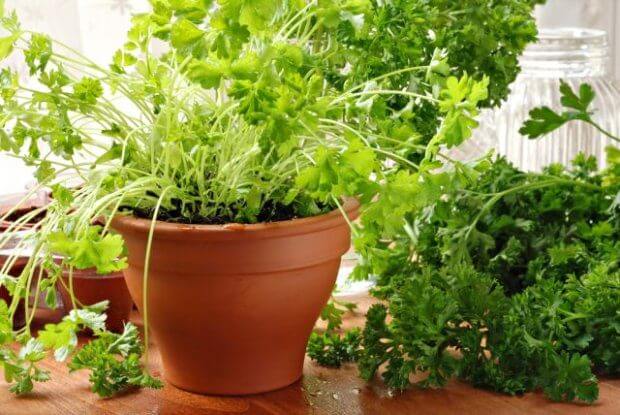
Parsley tea anyone? This may be a surprise suggestion as most of us know parsley as a tasty addition to meals but the truth is this green leafy herb packs some powerful health benefits, as both the leaves and roots have medicinal properties.
Parsley has a long history of traditional medicinal use and contains a range of biologically active compounds. Laboratory and animal research has identified several potentially useful pharmacological effects, but human clinical evidence remains limited.
It is particularly rich in flavonoids, including apigenin. Small human studies suggest that parsley-derived apigenin is absorbed and metabolised and that parsley intake may influence some antioxidant enzyme activity, although clinical research remains limited.
In my view and experience, parsley has so many nutrients that eating it is almost like taking a multivitamin, antioxidant and mineral supplement – one that is all natural and available at a fraction of the cost!
What Are Health Benefits of Parsley?
Here are some examples of how parsley may help:
- Improves skin texture and decreases wrinkle formation
- Aids digestion and elimination
- Boosts energy
- Relieves fatigue and supports the stress physiology
- Strengthens teeth
- Enhances nutrient absorption
- Decreases bloating
- Reduces inflammation
Parsley for Specific Health Conditions
Parsley for blemish-free skin
Parsley is a natural skin enhancer as it contains high levels of well-absorbed vitamin C in a matrix of other synergistic vitamins and minerals. Vitamin C is vital for many body functions but it’s absolutely essential for a healthy and glowing skin as it supports collagen synthesis.
It not only nourishes the skin but also reduces scars and blemishes by stimulating the production of collagen, which is the key to cell repair and thus fewer wrinkles! This is particularly important during perimenopause and menopause transition when skin needs more support.
Kidney Function and Urinary Tract Infections (UTIs)
Parsley has a long history of traditional use as a diuretic, although human evidence is limited. In a small study of healthy volunteers, drinking parsley leaf tea did not significantly increase urine volume or alter several measured urinary parameters compared with water. Clinically, I find it helpful with supporting kidney function and urinary tract infections. It can also provide general immune support because it’s rich in naturally occurring minerals and vitamins.
Digestion and Detoxification Aid
Parsley is high in chlorophyll – a blood purifier that aids in digestion and detoxification, particularly of the kidneys but also of the liver. And the herb packs in dense nutrients including:
- Vitamins – vitamin C (high content), beta carotene (provitamin A), vitamin K, and B vitamins including B1, B2, folate, B5, and B6.
- Minerals – calcium, magnesium, phosphorus, iron (high non-heme content), manganese, sulphur and potassium.
- Pyrroloquinoline quinone (or PQQ) – parsley is one of the best sources of PQQ, an essential nutrient and potent antioxidant that boosts the health, repair and function of mitochondria, our energy generators. PQQ has been found in many plant foods such as green capsicums, kiwi fruit, papaya and natto (fermented soy). Early human studies suggest that 20 mg of PQQ, alone or combined with 300 mg of CoQ10, may support some aspects of cognitive function in middle-aged and older adults.
To get the immune building, nutrient fortifying, and detoxification benefits, you’ll want to take parsley in some quantity (however, speak to your naturopath first about what amount would be beneficial for your circumstances). To achieve this, it’s best to juice or blend parsley with other fruits or vegetables.
Also, parsley can effectively refresh the breath. For example, it’s helpful to chew some parsley after eating fresh garlic.
Discover more guides and articles on gut, digestion and microbiome health in the Gut Health and Microbiome Resources Hub →
Fresh parsley can be used in many forms but one of the easiest is to make a parsley tea to sip throughout the day in addition to or instead of water. Try this simple parsley tea recipe:
Parsley Tea Recipe
Any kind of parsley is fine but flat leaf (Italian) parsley is more fragrant and less bitter than the curly variety.
- Put 3-4 teaspoons of minced parsley, including stems, in a medium teapot (800ml-1l) with an infusion basket.
- Pour the boiling water on top filling the teapot, let steep for 5-8 minutes.
- Remove the basket with the parsley and drink the liquid either hot or cold. It may be reheated but don’t boil it.
- Add a splash of fresh lemon (optional) to enhance the flavour and for more vitamin C.
- Drink up to 4 cups throughout the course of one day for 7 days to help with urinary tract or bladder infection. Otherwise have 2-3 cups between meals for a few weeks or a month to boost skin health, for better daily detox and immune support.
Caution: Please note that pregnant women should avoid taking parsley in quantity as it promotes uterine contractions.
When is the best time to drink parsley tea?
There is no single best time to drink parsley tea. For general use, it can be enjoyed between meals and spread throughout the day. If you find that drinking fluids or parsley tea increases urination, it may be more practical to have your last cup earlier in the evening rather than close to bedtime.
You can make a bigger portion and keep the infusion in the fridge for 1–2 days with the leaves removed, then enjoy it cold or reheated the next day. I actually prefer the flavour the next day, especially cold in summer. For the best flavour, try growing your own parsley in a pot or garden.
Enjoy the beneficial parsley tea and watch your skin becoming healthy, glowing and blemish free whilst your general health improves as well!
Discover more medicinal herbs in our Herbal Medicine Resources Hub → Browse more of our tried and tested, healthy and yummy recipes in the Recipes Hub → and key nutrition and good foods articles and guides in our Nutrition Hub →
Best of Health
Joanna Sochan
Wholistic Health and Lifestyle Therapist
Integrative health support combining clinical evidence, systems-based thinking and traditional naturopathic wisdom for lasting health and wellbeing
Additional Resources
- Top 3 herbal teas to feel and look great!
- Gotu kola: uses and benefits for skin, stomach ulcers and memory
- Dandelion: the key herb for liver health, better digestion and beautiful skin
- Psoriasis: a holistic approach to recovery
- 12 best avocado recipes: avocados for breakfast, lunch, dinner and desserts
References
Bahramsoltani R, Ahmadian R, Daglia M, Rahimi R. Petroselinum crispum (Mill.) Fuss (Parsley): An Updated Review of the Traditional Uses, Phytochemistry, and Pharmacology. Journal of Agricultural and Food Chemistry. 2024;72(2):956–972. PubMed
Alyami FA, Rabah DM. Effect of drinking parsley leaf tea on urinary composition and urinary stones’ risk factors. Saudi Journal of Kidney Diseases and Transplantation. 2011;22(3):511–514. PubMed
Nielsen SE, et al. Effect of parsley (Petroselinum crispum) intake on urinary apigenin excretion, blood antioxidant enzymes and biomarkers for oxidative stress in human subjects. British Journal of Nutrition. 1999;81(6):447–455. PubMed
Disclaimer: The above material is for informational and educational purposes only. It should not be used to self-diagnose and it is not a substitute for medical advice, diagnosis, treatment, prescription or recommendation. All viewers of this content, especially those taking prescription or over-the-counter medications, should not make any changes in their health regimen or diet before first consulting a doctor or other qualified health provider with any questions they may have regarding a medical condition or their particular circumstances.

Joanna Sochan is a Wholistic Natural Therapist and founder of Naturimedica Wholistic Wellcare. She has over 15 years of clinical experience working with complex health presentations, with a focus on gut health, food sensitivities, women’s hormone health (including perimenopause and menopause), metabolic health, weight regulation, and circadian health. She works with clients Australia-wide and online, and also develops therapeutic programs, eCourses, and educational resources designed to support long-term, sustainable wellbeing. View full bio.
You ought to be a part of a contest for one of the best blogs on the net.
I am going to highly recommend this blog!
Thank you for reading and for your feedback.
You’re welcome!
Thank you for this article. Will this help to get rid of melasma and liver spots as well and not just acne?
Definitely worth trying!
Thank you joanna Sochan
You’re welcome! Thank you for your comment:)